Short answer: A commercial food freeze dryer is priced mainly by drying area (m²), refrigeration capacity, cold-trap design, chamber material and automation. Compare quotes on cost per square metre of shelf area and on energy per kilogram of water removed, not on the headline price alone.
What determines the price of a commercial freeze dryer?
The single biggest driver is drying area — the total heated shelf surface, measured in square metres. Drying area sets how much wet product you load per batch (roughly 8–10 kg of wet material per m² for typical fruit slices), and it scales almost every other component: chamber size, refrigeration, cold trap and vacuum system.
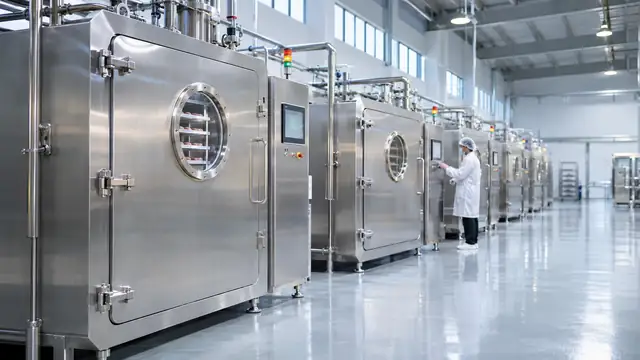
For reference, our QS-FD-20 has 20.16 m² and handles about 200 kg per batch, while the QS-FD-200 has 207.36 m² and handles about 2 tons.
The five cost drivers, in order of impact
- Drying area and chamber construction. Square SUS304 chambers with welded square-tube reinforcement cost more to build than thin cylindrical vessels, but they use space and energy better.
- Refrigeration system. Reaching −60 °C reliably needs a two-stage or cascade compressor. Brand of compressor, valves (we use Danfoss TEX2 and EVR) and condensing type (air, water or evaporative) all change the price.
- Cold trap. Pure copper-tube coils transfer heat far better than stainless coils and capture ice faster, but copper costs more.
- Heating and control. Independent heating zones, PT100 product probes with ±0.1 °C accuracy and recipe-based PLC control add cost — and add product quality.
- Logistics and installation. Industrial lines need on-site installation supervision, refrigeration piping and commissioning.
How to compare two freeze dryer quotations
Ask every supplier for the same five numbers: drying area in m², tray count and size, ultimate refrigeration temperature, cold-trap material and area, and total installed power. Then calculate:
- Price per m² of drying area — the fairest like-for-like metric.
- kW per m² — a quick indicator of running cost.
- Batch capacity in kg of wet material — check it against your daily target.
| Model | Drying area | Wet capacity / batch | Installed power |
|---|---|---|---|
| QS-FD-20 | 20.16 m² | ≈ 200 kg | 35 kW |
| QS-FD-100 | 103.68 m² | ≈ 1,000 kg | 135 kW |
| QS-FD-200 | 207.36 m² | ≈ 2,000 kg | Per configuration |
Hidden costs to budget for
Freeze drying is energy-intensive. Budget for electricity, a pre-freezing room or blast freezer for track-type lines, trays and trolleys, packaging with low water-vapour transmission, and spare parts. A compressor that stops automatically as product dryness rises — standard on our machines — typically runs at about 60% of rated power.
Is a used or home freeze dryer an alternative?
Home units dry a few kilograms per batch and are not built for continuous duty or food-safety audits. For any commercial volume, a purpose-built industrial chamber pays back in throughput, consistency and lower energy per kilogram.
Want an exact price? Send us your product, daily output and voltage and we will reply with a configuration and quotation within one business day.
Related Questions
What is the cheapest way to start commercial freeze drying?
Start with a single commercial chamber such as the 20 m² QS-FD-20 (≈200 kg/batch). It is a true production unit, so it is not wasted when you later add an industrial line.
How much electricity does a commercial freeze dryer use?
Installed power for a 20 m² unit is about 35 kW; actual average draw is lower because the compressor stops automatically as the product dries. Energy per batch depends on product moisture and thickness.